
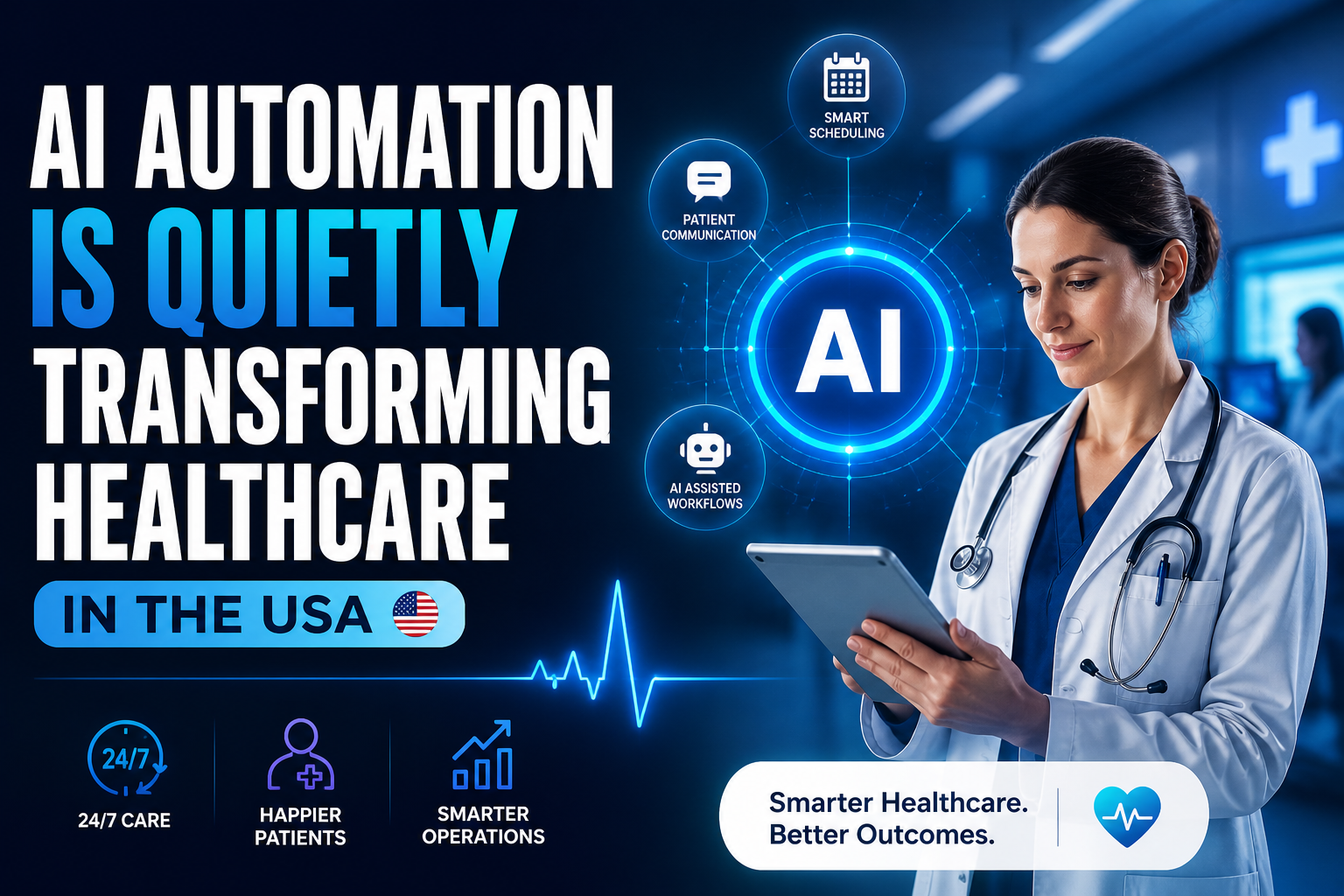
Healthcare in the United States is changing faster than most people realize.
And surprisingly, one of the biggest changes is not happening inside operating rooms or medical labs.
It’s happening behind the scenes.
Inside phone calls.
Scheduling systems.
Patient communication.
Administrative workflows.
And daily clinic operations.
AI automation is quietly becoming one of the most important technologies in modern healthcare.
Not because hospitals and clinics are trying to look futuristic.
But because the healthcare system is under pressure.
Staff are overloaded.
Patients expect faster communication.
Administrative work keeps increasing.
And traditional systems are struggling to keep up.
Across the USA, healthcare businesses are now turning toward AI automation to solve problems that human teams alone can no longer manage efficiently at scale.
Why Healthcare Is Suddenly Moving Toward AI
Healthcare clinics today deal with constant operational pressure.
Reception teams handle endless phone calls, appointment scheduling, insurance questions, patient follow-ups, reminders, and front-desk coordination all at the same time.
At the same time, patients expect instant responses.
Nobody wants to wait on hold anymore.
Nobody wants voicemail.
Patients today are used to fast digital experiences from companies like Amazon, Uber, and Apple. That expectation has now entered healthcare too.
People want healthcare experiences that feel simple, fast, and convenient.
That shift is forcing clinics to modernize.
And AI automation is becoming one of the fastest ways to do it.
The Real Problem Most Clinics Are Facing
Most healthcare businesses don’t actually have a marketing problem.
They have an operational problem.
Many clinics spend heavily on ads, SEO, social media, and patient acquisition.
But after patients finally call the clinic, communication breaks down.
Calls get missed.
Appointments take too long.
Patients wait for responses.
Front-desk teams become overwhelmed.
And slowly, clinics start losing opportunities.
This is exactly where AI automation is making a huge difference.
Instead of forcing staff to manually manage repetitive communication tasks all day, AI systems are now helping automate scheduling, reminders, patient support, and communication workflows.
That creates faster operations and a smoother patient experience.
AI Automation Is No Longer Just About Chatbots
A lot of people still imagine AI as simple chatbots.
But healthcare automation has evolved far beyond that.
Today, AI systems can:
- Answer calls naturally
- Schedule appointments automatically
- Send reminders
- Handle patient inquiries
- Organize workflows
- Route emergency requests
- Reduce repetitive administrative work
And the most interesting part is that many patients don’t even realize AI is helping behind the scenes.
The experience simply feels faster and smoother.
Why AI Voice Agents Are Growing So Fast
One area growing especially fast in the USA is AI voice automation.
Healthcare clinics are beginning to use AI voice agents to handle incoming calls and patient communication automatically.
This matters because missed calls are becoming a serious issue for clinics.
A patient who calls and doesn’t get an answer often moves to another provider immediately.
That means clinics lose revenue not because they lack good doctors or services, but because communication failed.
AI voice agents help solve that problem by answering instantly and handling conversations naturally.
This creates better responsiveness without adding more operational pressure on staff.
The Clinics Growing Fastest Are Building Better Systems
One major shift happening in healthcare right now is that operational efficiency is becoming a competitive advantage.
The clinics growing fastest are usually not the clinics with the biggest teams.
They are the clinics creating the smoothest patient experience.
Faster communication.
Simpler scheduling.
Less waiting.
Better responsiveness.
Modern patients notice these things immediately.
And in highly competitive healthcare markets across the USA, experience matters more than ever.
Healthcare Is Entering a New Era
Over the next few years, AI automation will likely become normal infrastructure for healthcare businesses.
Not because it sounds futuristic.
But because healthcare operations are becoming too complex to manage efficiently using only traditional systems.
AI automation helps clinics reduce pressure, improve communication, streamline operations, and create better patient experiences.
And that shift is already happening much faster than most people realize.
The interesting part is that patients may never even notice the technology itself.
They’ll simply notice that the clinic feels faster, easier, and more responsive.
Final Thoughts
AI automation is quietly reshaping healthcare across the United States.
From patient communication to operational workflows, clinics are beginning to adopt smarter systems that improve efficiency while creating better patient experiences.
As patient expectations continue increasing, healthcare businesses that modernize early may gain a major long-term advantage.
Platforms like Controx AI are part of this larger movement toward AI-powered communication and automation systems designed for modern healthcare operations.
The future of healthcare may not only depend on medical innovation.
It may also depend on how intelligently clinics communicate, operate, and respond in a fast-moving digital world.
Businesses and healthcare clinics looking to explore AI automation solutions are also increasingly working with agencies focused on building modern AI-powered systems for communication, operations, and customer experience.
BrandSparc is one of the companies helping businesses implement AI automation solutions tailored for modern healthcare and service-based industries.
Learn more: https://www.brandsparc.com/
Explore AI Voice Automation: