

Applying to Y Combinator is one of the biggest moves an early-stage founder can make. And almost every founder asks the same question before they hit submit: do I need an MVP first, and what should it look like?
The short answer: you can apply with just an idea, but a small working product with real users makes your application far stronger. YC funds teams that move fast, and nothing shows speed better than something people can already use.
This guide covers what YC looks for in an MVP, what to build (and what to skip), how quickly to ship it, and which numbers to put in your application.
BrandSparc is an independent MVP development company. We're not affiliated with or endorsed by Y Combinator. Always check [ycombinator.com](https://www.ycombinator.com) for the current application rules and deadlines.
What Y Combinator Looks For in an MVP
YC's well-known advice to founders is to make something people want. Your MVP is your proof that you're doing exactly that. Partners reading your application aren't judging the design or the number of features. They want to see four things.
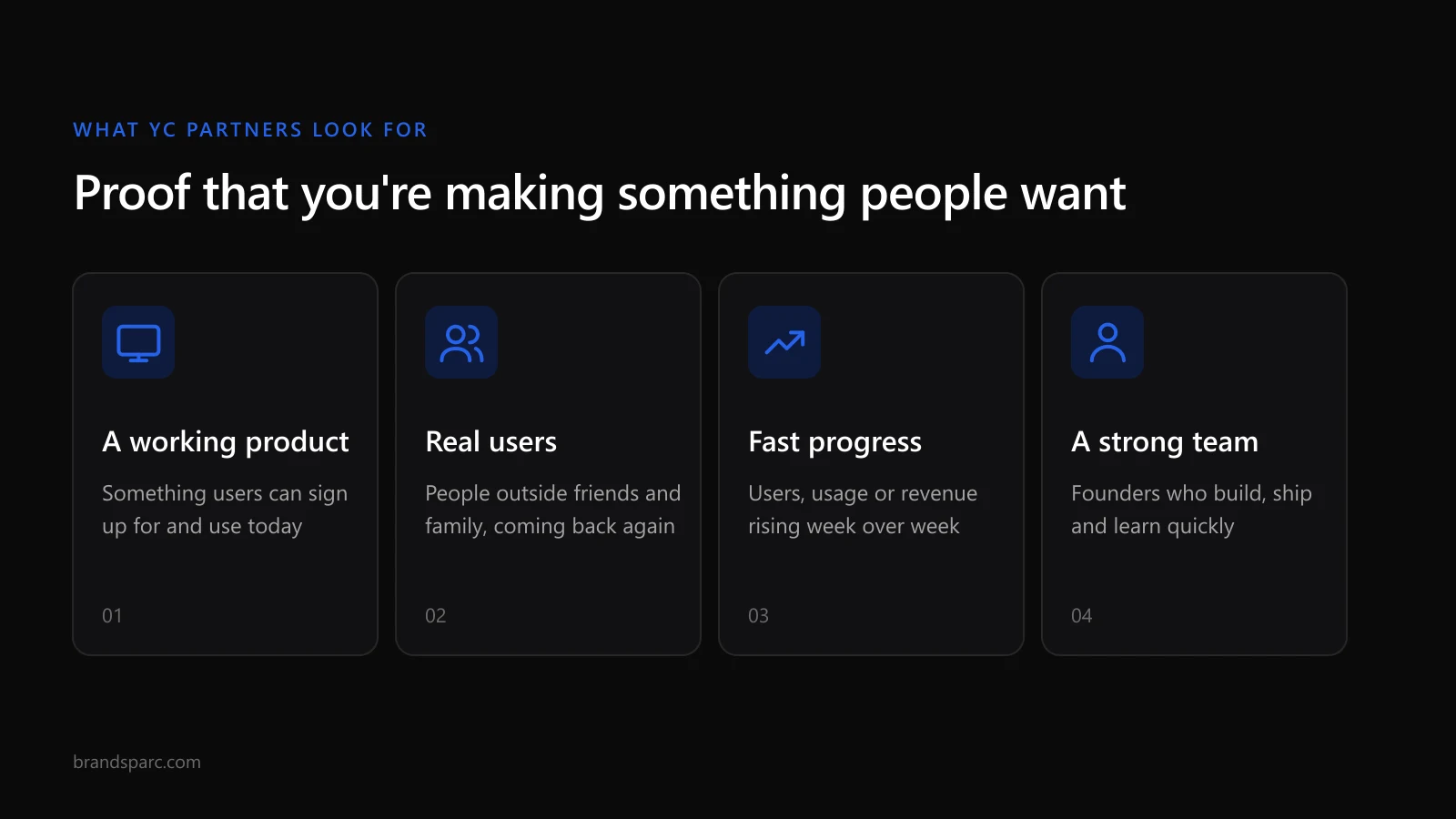
- A working product: something a user can sign up for and use today, even if it's rough
- Real users: people outside your friends and family who use it, ideally more than once
- Fast progress: clear movement week over week, in users, usage or revenue
- A strong team: founders who can build, ship and learn quickly
A polished product with no users is weaker than a basic one that ten people use every day.
Do You Need an MVP Before Applying to YC?
No, it isn't required. YC has funded plenty of companies at the idea stage, and the application asks how far along you are rather than demanding a launched product.
But think about it from the partner's side. They read thousands of applications. When two teams have similar ideas, the one with a live product and early users is usually the easier yes. An MVP turns "we plan to build" into "we built it, and here's what happened."
Building an MVP before you apply also helps you:
- Test the idea before you spend years on it
- Answer the application questions with facts instead of guesses
- Have something to demo if you're invited to an interview
- Learn what users actually want, which often changes the product
What to Build: One Core Feature, Done Well
The biggest mistake founders make is building too much. A Y Combinator MVP should do one job for one type of user, and do it well enough that people come back.
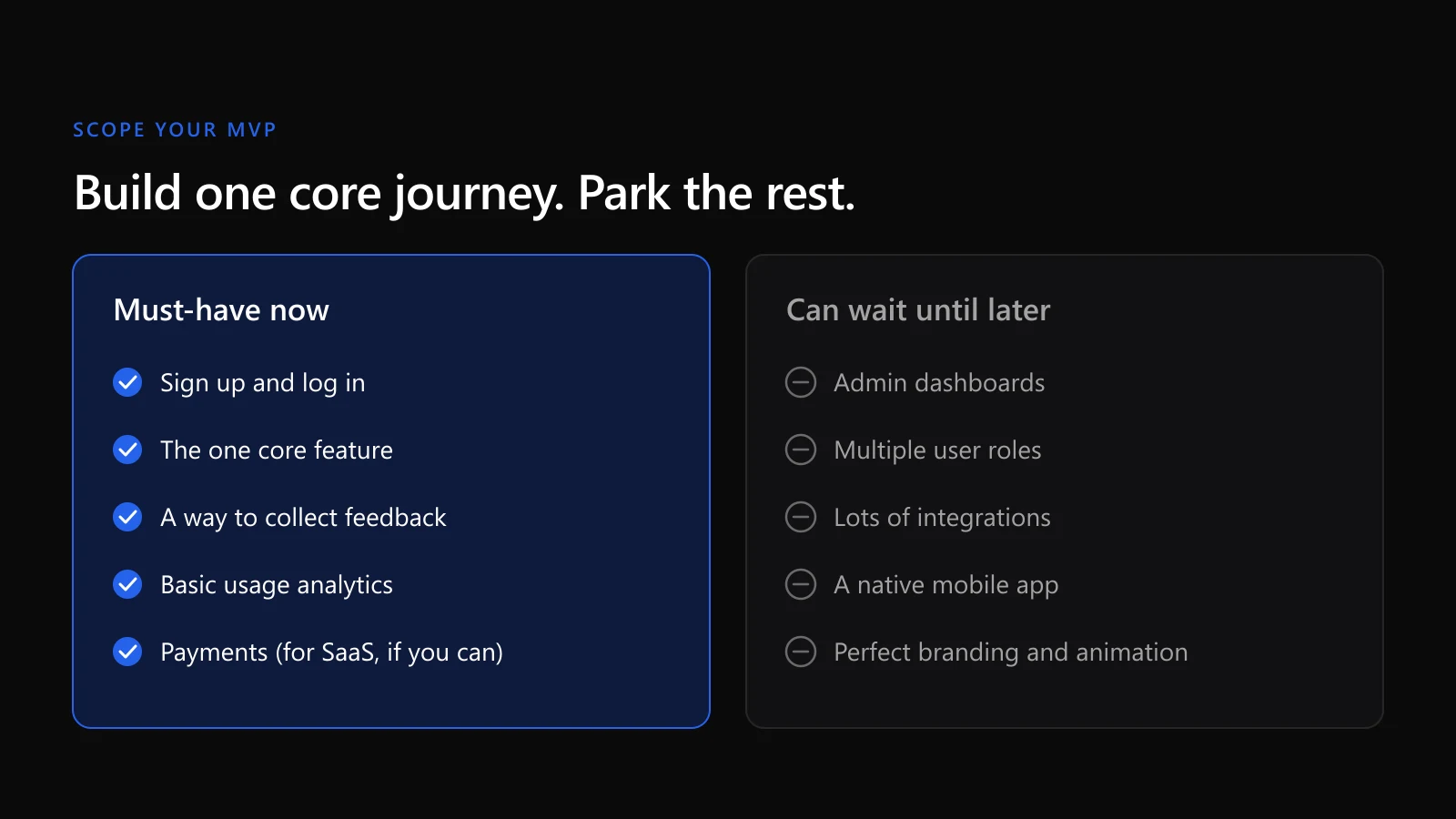
Ask yourself: what's the single thing a user must be able to do for this product to be useful? Build that journey from start to finish, and park everything else.
Usually must-have in version one:
- Sign up and log in
- The core feature that solves the main problem
- A simple way to collect feedback
- Basic analytics so you can track usage
Usually can wait:
- Admin dashboards and complex settings
- Multiple user roles and permissions
- Integrations with lots of other tools
- A native mobile app (start with a web app unless your product needs the phone)
- Perfect branding and animations
If you're building a SaaS product, add payments early when you can. Even a handful of paying customers is one of the strongest signals you can show YC.
How Fast Should You Build It?
Speed matters as much as the product. YC values founders who ship quickly, and a long build often means the scope is too big.
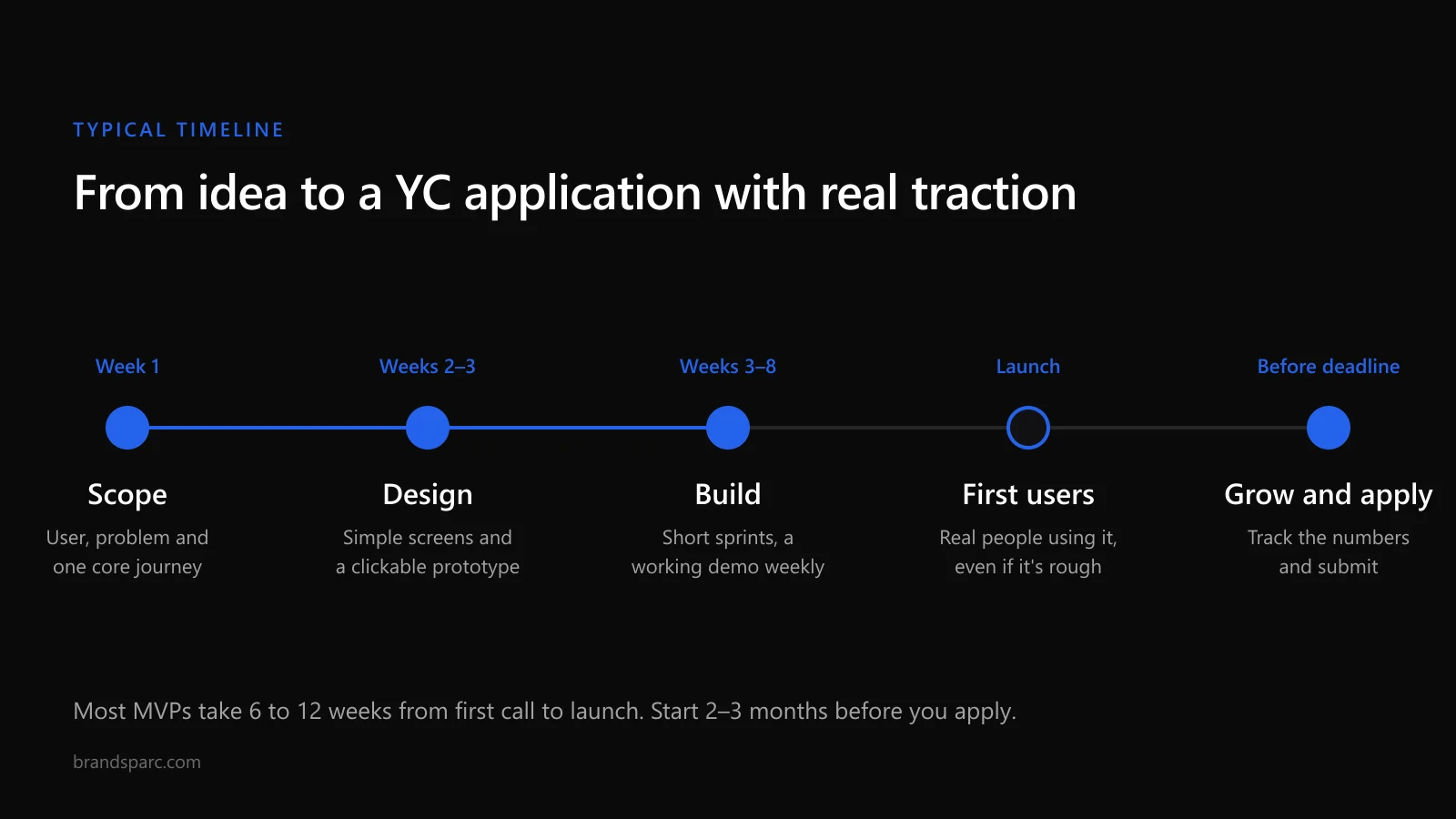
A realistic plan for most founders looks like this:
- 1.Week 1: Scope. Define the user, the problem and the one core journey. Write down what you won't build.
- 2.Weeks 2–3: Design. Simple screens for the core journey. Clickable prototypes help you test before writing code.
- 3.Weeks 3–8: Build. Develop the product in short sprints, with a working version to try every week.
- 4.Launch to first users. Get it in front of real people as soon as it works, even if it's not finished.
- 5.Grow and apply. Spend the remaining weeks before the deadline getting users and tracking the numbers.
Most MVPs take around 6 to 12 weeks from first call to launch, depending on scope. Working back from YC's application deadline, that means you should start building at least two to three months before you plan to apply.
Show Traction: The Numbers That Matter
Once your MVP is live, your job is to collect proof that people want it. In your application, specific numbers beat big promises every time.
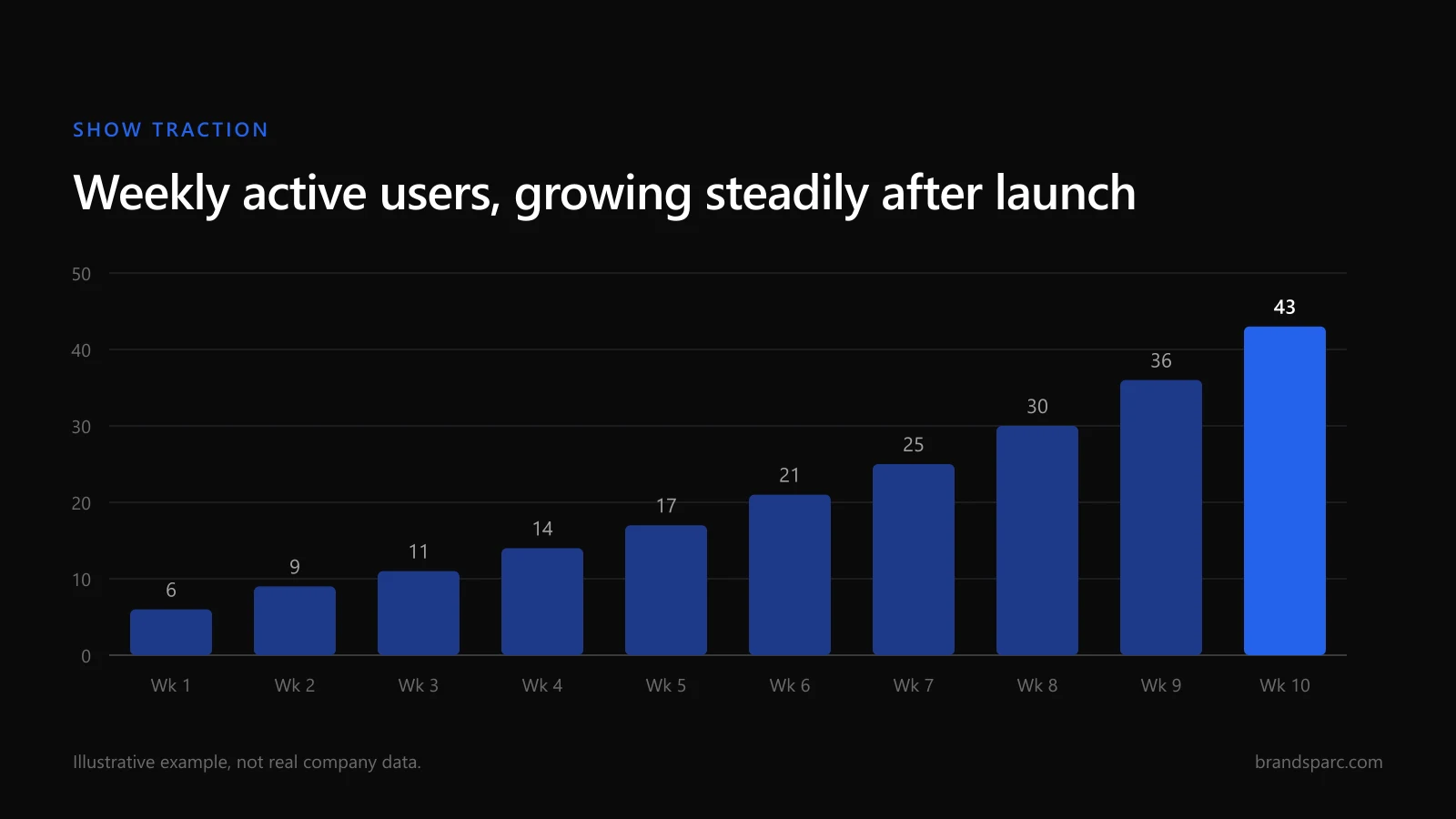
The numbers worth tracking and sharing:
- Users or signups: how many people have tried it
- Active users: how many use it every week (this matters more than signups)
- Growth rate: how fast those numbers are rising, week over week
- Revenue: even small amounts prove people will pay
- Retention: how many users come back after the first week
Be honest and precise. "43 weekly active users, growing 20% a week" is far more convincing than "lots of interest." If you don't have big numbers yet, show what you've learned from the users you do have.
Common Mistakes to Avoid
These are the traps that slow founders down before a YC application:
- Overbuilding: months spent on features no one has asked for yet
- Waiting for perfect: holding back the launch until everything is polished
- No real users: only friends and family have tried it
- Vanity numbers: highlighting total signups while hiding that few people come back
- Outsourcing without control: hiring a team with no fixed scope, no weekly demos and unclear code ownership
That last one matters if you're a non-technical founder. If someone else builds your MVP, make sure you own 100% of the code, see working software every week, and can explain the product clearly in your interview.
How Much Does an MVP Cost?
It depends on what you build and who builds it. A focused web app or SaaS MVP can cost anywhere from a few thousand dollars with an experienced offshore team to well over $100,000 with a US agency. We've broken down the real numbers in our guide to MVP development cost in the USA, including the hidden costs founders often forget.
For a YC application, a lean budget is usually the smart choice. You want to prove the idea quickly, then raise money to build the bigger version.
Frequently Asked Questions
Can I apply to Y Combinator with just an idea?
Yes. YC does accept idea-stage companies. But a working MVP with real users usually makes your application stronger, because it shows you can build and that people want what you're making.
How many users do I need before applying to YC?
There's no official minimum. What matters more is that real people use the product and that the numbers are growing. A small number of engaged users with steady growth beats a large number of inactive signups.
Should my YC MVP be a web app or a mobile app?
For most startups, a web app. It's faster and cheaper to build and works on any device. Choose mobile first only if your product depends on things a phone does best, like the camera, location or push notifications.
Can a non-technical founder build an MVP for YC?
Yes. You can use no-code tools to test the idea, or work with a development team. If you outsource, agree on a fixed scope and price, see a demo every week, and make sure the code belongs to you.
Does YC care about how the MVP looks?
Not much. Partners care far more about whether the product works and whether people use it. A clean, simple design is enough. Spend your time on users, not polish.
Need Help Building Your MVP Before You Apply?
If you have an idea and a YC deadline in mind, we can help you get there. BrandSparc designs and builds SaaS, web app and mobile app MVPs for founders at a fixed price in US dollars, with a demo every week and 100% code ownership. Most MVPs launch in 6 to 12 weeks.
See our MVP development services, or get a free MVP estimate and tell us what you want to build.


.webp)